Commercial Lock Upgrades for Small Businesses in the Florida Panhandle
Is your business running on the same locks it had when it opened? Here is what small business owners in the Panhandle should know about upgrading to commercial-grade security — and why it matters more than most owners realize.
Most small business owners think about security after something goes wrong. A break-in, a former employee who still has a key, a lock that finally gives out after years of daily use. By then, the damage is done — financially and in terms of peace of mind.
If your business is running on the same hardware it had when it opened, or if you have never had a professional assess your entry points, this post is for you. Commercial lock security is not complicated, but it is different from residential security in ways that matter. Here is what Panhandle business owners need to know.
Why Commercial Locks Are Different
The locks on your home and the locks on your business are not the same product, even if they look similar from the outside. Commercial-grade hardware is built for higher cycle counts — a business door may open and close hundreds of times a day, compared to a handful of times at a residence. Residential locks wear out faster under that kind of use.
Beyond durability, commercial locks are designed with access control in mind. Who has a key? Who had a key six months ago? Can you restrict access to certain areas without changing every lock in the building? These are questions that residential hardware was never built to answer.
For small businesses in Panama City, Lynn Haven, and Panama City Beach, the stakes are real. Retail shops, medical offices, salons, restaurants, and service businesses all have assets worth protecting — inventory, equipment, client records, cash, and the trust of the people who work there.
The Most Common Weak Points We See
When we assess a commercial property, the same vulnerabilities come up repeatedly:
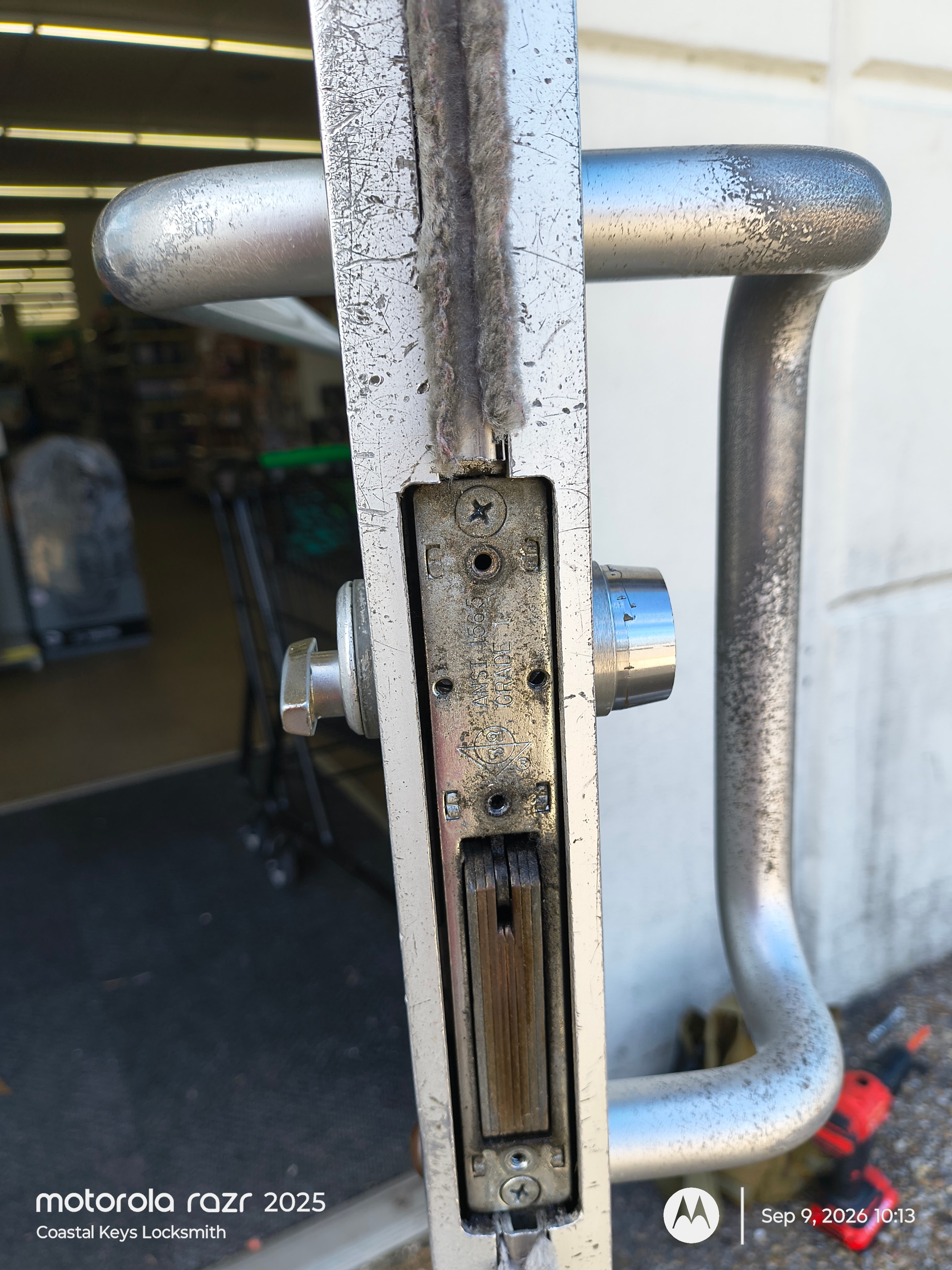
Worn or low-grade deadbolts on the primary entry. Many small businesses open in leased spaces that already have locks installed. Those locks may be years old, may have been rekeyed multiple times, and may not meet current commercial standards. A Grade 1 ANSI/BHMA deadbolt is the minimum for any exterior commercial door — many businesses are running Grade 2 or Grade 3 hardware that was never meant for commercial use.
No control over who has keys. Over time, keys get copied, passed around, and lost. A business that has been open for three or more years often has no accurate record of how many key copies exist. Former employees, contractors, cleaning crews, and delivery personnel may all have had copies made. Rekeying on a regular schedule — or switching to a keypad or access card system — eliminates this problem entirely.
Hollow-core or poorly reinforced doors. A high-quality lock on a weak door is not much of a deterrent. We regularly see commercial doors with inadequate strike plates, short screws, and door frames that have never been reinforced. A solid lock paired with a reinforced frame and a heavy-duty strike plate is far more effective than an expensive lock on a flimsy door.
No secondary access control on interior spaces. If your business has a back office, a server room, a pharmacy area, or any space that should be restricted to certain staff, a single front-door lock is not enough. Interior access control — whether keyed locks, keypads, or card readers — limits exposure if someone does get inside.
Lock Upgrade Options Worth Considering
The right upgrade depends on your business type, how many people need access, and how much control you want over who can get in and when. Here is a practical breakdown:
Rekey the existing locks. If your hardware is in good condition but key control is the issue, rekeying is the fastest and most affordable fix. Every existing key stops working, and you start fresh with new keys cut to a new configuration. We recommend rekeying any time an employee with key access leaves the business — regardless of whether the departure was amicable.
Upgrade to Grade 1 commercial deadbolts. If your current locks are residential-grade or showing wear, replacing them with ANSI Grade 1 commercial deadbolts is a straightforward upgrade. These locks are built for high-traffic use and provide significantly more resistance to forced entry.
Install a keypad or electronic access system. Keypad locks eliminate the key-copy problem entirely. You assign codes to employees, and you can change or delete individual codes without touching the hardware. Some systems log entry history, so you can see who entered and when. For businesses with multiple staff members or shift-based schedules, this is often the most practical long-term solution.
Add a high-security deadbolt with restricted keyways. High-security locks use patented keyways that cannot be duplicated at a hardware store or big-box retailer. Keys can only be copied by an authorized locksmith with the proper credentials. This is a good option for businesses that prefer physical keys but want to prevent unauthorized duplication.
Reinforce door frames and strike plates. This is often the most overlooked upgrade. A standard strike plate is held in place by short screws that go into the door casing, not the structural frame. Replacing it with a heavy-duty strike plate secured by 3-inch screws into the stud dramatically increases resistance to kick-in attacks — one of the most common methods of commercial break-in.
When to Call a Commercial Locksmith
You do not need to wait for a problem to justify a security assessment. There are several situations where calling a commercial locksmith proactively makes sense:
- When you open a new location — even in a brand-new space, you do not know who has keys from the construction phase
- When an employee with key access leaves — regardless of the circumstances
- When you renew or take over a lease — the previous tenant's keys are still out there
- When you add staff or change shift structures — access control should reflect who actually needs to be where
- After any break-in or attempted break-in — even if nothing was taken, the vulnerability that allowed access still exists
We serve businesses throughout the Panhandle, including Panama City, Lynn Haven, Panama City Beach, and surrounding communities. Most commercial jobs are same-day, and we come to you — no need to bring anything in or close during business hours.
What a Commercial Security Assessment Looks Like
When we visit a commercial property, we walk every exterior entry point, assess the hardware grade and condition, check door frame integrity, and look at any interior access control needs. The assessment takes 20–30 minutes for most small businesses. We give you a clear picture of what is working, what is not, and what upgrades would make the biggest difference for your specific situation — with no pressure to do everything at once.
From there, you can prioritize based on your budget and timeline. Some businesses start with a rekey and a strike plate upgrade. Others move straight to a keypad system. We work with what makes sense for your operation.
To schedule a commercial security assessment or get a quote on a specific upgrade, book online or call us at (850) 225-1529. You can also learn more about our full range of commercial locksmith services for businesses throughout the Panhandle.
Frequently Asked Questions
How often should a small business rekey its locks? At minimum, any time an employee with key access leaves the company. Beyond that, an annual rekey is a reasonable baseline for businesses with regular staff turnover or high foot traffic. If you have lost track of how many key copies exist, that is a sign it is time to rekey now.
What is the difference between a Grade 1 and Grade 2 commercial lock? ANSI/BHMA grades rate locks on durability and security. Grade 1 is the highest commercial rating — built for heavy-use applications and tested to withstand more force and more cycles than Grade 2 or Grade 3. Most exterior commercial doors should have Grade 1 hardware. Grade 2 is acceptable for interior doors with moderate traffic.
Are keypad locks more secure than traditional keyed locks? Keypad locks solve the key-control problem — there are no physical keys to copy or lose. Whether they are "more secure" overall depends on the specific hardware. A commercial-grade keypad deadbolt is an excellent choice for most small businesses. We can recommend specific models based on your door type and access needs.
Can you install locks without disrupting my business hours? Yes. Most commercial lock installations and rekeying jobs take under an hour per door. We work around your schedule and can typically complete the work during off-hours, early morning, or between shifts if needed.
Do you service businesses outside of Panama City? Yes. We serve the full Florida Panhandle including Lynn Haven, Panama City Beach, and surrounding Bay, Gulf, Franklin, Calhoun, and Washington counties. Call or book online and we will come to your location.
Explore Topics
Written by
DJ — Coastal Keys Locksmith
Content creator and writer sharing insights and stories.